

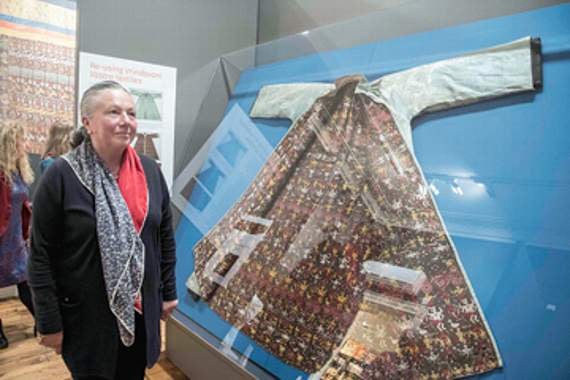
A NEW exhibition at Chepstow Museum, specially created in partnership with the British Museum, explores the origins and stories of stunning silk textiles from temples in India.
One of the exhibits in the exhibition, entitled Krishna in the Garden of Assam, is an extremely rare example which comes from the collection of Monmouthshire Museums.
The exterior is of an elegant 18th century gentleman’s dressing gown known as a banyan – but hidden inside is a magnificent lining, woven in Assam, and which is one of only 20 known to survive around the world.
The textiles are known as Vrindavani Vastra, which means the cloth of Vrindavan, – a forested region in north India where the Hindu god Krishna is believed to have lived as a young cowherd early in his eventful life.



The British Museum Vrindavani Vastra textile travelled from Assam to a Buddhist monastery in Tibet, while the textile that was cut to make the lining of the banyan that stars in the exhibition, travelled a different route to the West.
Combined with a subtle Chinese blue green damask silk the dressing gown was probably made in Calcutta for a European man who had made his fortune in India.
New light has been shed on the possible identity of the owner, and how it came to be among a collection of 18th century costume in Monmouthshire….
Dramatic scenes from Krishna’s life are woven into these vibrant strips of cloth – the same scenes feature in dance dramas performed with elaborate masks that are still distinctive to the region.
Masks, made by monks in Assam, and textiles have been loaned by the British Museum, and two beautifully illustrated pages from the finest Assamese manuscript in the British Library are also in the exhibition.
The scene is set with some film made in Assam featuring the masked dramas in preparation and performance.
The largest surviving example of the Vrindavani Vastra type of textiles, now in the British Museum, is more than nine metres in length.
It is made up of 12 separate lengths of cloth woven in Assam, which were stitched together later, probably in Tibet, with strips of damask and brocade along the top.
Chepstow Museum curator Anne Rainsbury said: “As it was impossible to display the original British Museum textile here in Chepstow, it has been reproduced by digitally printing onto fabric.”
The museum has recruited a number of volunteers to help explain the exhibits to visitors.
One of them, Linda Hailes, said: “The exhibition is absolutely stunning. The more you find out, the more you want to know.
“As a model-maker I particularly love the masks.”
This exhibition at Chepstow Museum runs until September 3 and there will also be a series of events in association with it.
Comments
This article has no comments yet. Be the first to leave a comment.