

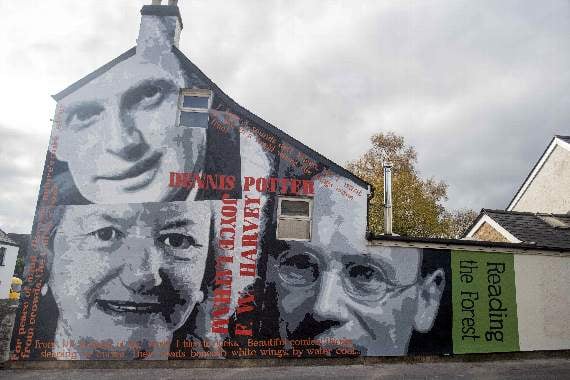
THREE Forest authors gaze down on one of the main entrances into Coleford – but this is no memorial to past glories.
The writers – FW Harvey, Joyce Latham and Dennis – who feature in the mural on the side of a former pub remain “super relevant” today, says academic Jason Griffiths, the principal investigator with the Reading the Forest project which commissioned the mural.
The mural is on the side of a house – which was formerly a pub called variously the Help Me Through the World and the Mason’s Arms on the junction of Boxbush Road and Bank Street was created by Forest-based artist Tom Cousins.
It celebrates the three authors with links to the western part of the Forest and is a companion piece to another of Tom’s murals in Cinderford which highlights three authors from the east Dean.


The mural was officially launched at a ceremony at the 16 community cafe nearby which was attended by members of the authors’ family and supporters of Reading the Forest which is part of the wider Heritage Lottery Fund-backed Foresters’ Forest project.
Mr Griffiths, of the University of Gloucestershire, said all three writers remained relevant today and he hoped the mural would spur people into discovering – or rediscovering – them.
He said: “These three writers have sadly passed away but they are super, super relevant to us today.
“The Forest of Dean is a wonderful but complicated place which is sometimes difficult to explain, so it about nature but its also about the industry.
“Its about all the other things that makes the Forest of Dean special and the interaction of all of those things.
“They (the authors) are absolutely not in the past and now we can’t ignore them because they are two storeys tall on that building.
“It will be a prompt for all us to revisit their work and remind ourselves about this wonderful place.
While there is a temptation to look at the trio’s work through the lens of nostalgia or heritage that would be to diminish the power of what they had to say for today’s audiences.
Mr Griffiths said: “The Forest is a fantastic place but it’s complex – what these writers do, and why they are super relevant today – is they are writing about this place and what makes it so special to us.
“There is a wonderful interview with Dennis Potter, who I’m massively enthusiastic about because I think he’s really important and fantastic, as are all the writers.
“He was asked about nostalgia because a lot of his work seemed to look to the past and he said: ‘I’m not too keen on the word nostalgia because nostalgia is looking back to the past in the past and its safe and its cosy and warm and we look back to it.’
“He said actually the past runs alongside us all the time and is part of who we are.
“It’s never buried in the past, it is present with us now and I think that is what is so important about looking at our literary heritage.
“Heritage is a loaded word - it pushes it into the past, heritage is part of who we are and the place where we live.
“I think too often we mythologise the Forest in a kind of pixies and fairies kind of way when it is actually a very real place.
“There’s a wonderful line from Joyce Latham in which she says there weren’t any fairies at the bottom of her garden, there was a privvy.”
Joyce Latham did not become a published author until later in life and was a much-loved character, said Roger Deeks of Reading the Forest.
He said: “There are lots of people who remember her very well – not as someone who wrote books and poems but as a mother and grandmother.
“She is a greatly loved character and as an author she was quite an inspiration.”
In the past it was a challenge to become a writer in a place like the Forest, said Mr Deeks.
He said: “Joyce wasn’t given the greatest opportunities after she was born – her mam was her grandmother and she had the cloud of illegitimacy, which at the time she was born was a terrible thing.
“It affected the opportunities she had andJoyce was blighted by that.
“She was also committed to her family and where she lived.
“Her books and poems were all about where she lived and they are beautifully written.
She did not get published until much later in life and you look at her and think what if she had privilege and opportunity?
“What if she had started writing years before, would her canon of literature have been much bigger?
“Yes it probably would but it would have been much different because it wouldn’t tell the story it tells abut growing up in the Forest at the end of the Second World War and facing the challenges she did as the Forest changed.
“She is a marvellous writer and an absolute inspiration and what made her a special person was that she would use her poems in many different ways – so if she was writing a card she would include a little verse.”
While Joyce Latham’s writings were very much of the Forest, FW – Will – Harvey had a national reputation for his poetry inspired by a soldier’s life in the First World War and for his verse about Gloucestershire.
Mr Deeks said: “In his time Will Harvey was probably more famous than Wilfred Owen.
He was the most famous poet at the end of the First World War. nationally known for his poems about Gloucestershire.”
Harvey was a prisoner of war and returned to Gloucestershire with what would now be diagnosed as post-traumatic stress disorder (PTSD).
Born at Hartpury and raised in Minsterworth – where there is now a stained glass window in the church in his honour – he spent the last 30 years of life in Yorkley.
Although a writer, and famous as a broadcaster, his ‘day job’ was as a solicitor and he became known as the “poor man’s advocate”.
Mr Deeks said: “I think it was one of the traits of all these authors, their commitment and their care for their people around them and their communities.
“Everything he did was a celebration of life.”
“In Yorkley he really settled into Forest culture and he was fascinated by dialect – he had the gift of being able to speak what we call proper English and could switch to dialect which made him very accessible.
“He learnt all about Forest folklore and he was a humorist so some of his later poetry is famous for being in dialect.
“He picked up all these stories about the locality and one of his best is called Warning in which he weaves all the stories he has heard about the Forest.”
His poem Ducks is still hugely popular and appeared in a BBC poll of the UK’s 100 favourite poems.
Dennis Potter was born in Berry Hill and went on to become a major figure in television and film, still influencing the art forms 24 years after his death.
Mr Griffiths said: “He never forgot where he was from – many of his plays and dramas not only featured the Forest of Dean they were filmed here and featured local people as extras.
“The Forest of Dean was very important to him.”
In a television interview with Melvyn Bragg shortly before his death, he spoke fondly of the Forest.
“It is a strange and beautiful place with a people who are as warm as anywhere else but they seem warmer to me and the accent is so strong it is almost like a dialect.”
His last plays for television, Karaoke and Cold Lazarus – which are unique as co-productions between Channel 4 and the BBC – were linked and the latter featured the building which is now home to the mural as a backdrop.
The pub is now a house owned by Don and Cath Burgess who gave permission for the mural to be painted there.
As well as backdrop for a Dennis Potter play, it has a link to another of the three authors, in that Joyce Latham worked behind the bar when it was the Mason’s Arms.
Mr Burgess said: “I think it looks fantastic and it is in the perfect position on the main road into Coleford.”
Leaflets explaining more about the authors and their lives are available in Cinderford and Coleford.
To find out more about the Reading the Forest project visit www.reading
theforest.co.uk
----------
Authors of East Dean
THE first of the two murals celebrating the literary heritage of the Forest was painted in Cinderford and was unveiled back in July of the year.
Like its counterpart in Coleford, it celebrates three author with strong ties to their part of the Forest.
Winifred Foley found fame both in the UK and internationally later in life with her memoir A Child in the Forest which told of her childhood in what was the remote Forest of Dean in the 1920s.
Leonard Clark was a nationally notable literary editor and poet whose circle included people of the stature of Poets Laureate Ted Hughes and Sir John Betjeman.
Harry Beddington was a poet, champion of Forest dialect and an astute commentator on life in the Dean.
The artwork, painted by Tom Cousins, is, appropriately, given its literary subject, on the side of the Ripping Yarns wool shop in Woodside Street.
Comments
This article has no comments yet. Be the first to leave a comment.