
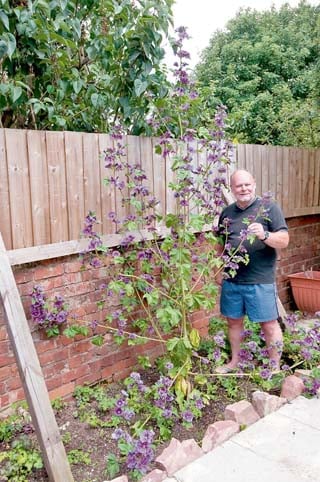
SUGGESTIONS as to the identity of Cinderford's towering plant mystery have come in thick and fast.
Reader Susan Jane Smith of Counselling in the Forest Publishing has suggested that Ken Hartley's eight foot tall mystery plant is a hardy lavatera.
She says: "From the photo (taken in Mr Harley's Belle Vue Road garden in Cinderford) I would say this was a hardy lavatera – normally pink shades but by looking at the shape of the flowers and the shape of the leaves this is what I would think."
Mrs Roberts of Parkside, Coleford, begs to differ. She thinks it is a member of the hollyhock family – and she should know, they've got about 37 in the garden.




Back on the mallow trail, but in a mutated version, are Alastair and Allison McCulloch of Coleford.
"My wife Allison believes that the plant may be a mutated Althaea (Marsh Mallow) plant. Helpfully they've supplied a link for those keen to solve the mystery – http://en.wikipedia.org/wiki/Althaea">http://en.wikipedia.org/wiki/Althaea_(genus)
And agreeing on the Lavatera is Sue Trigg, also from Cinderford, who comes up with an intriguing nickname for the plant – the 'candyfloss flower'.
She says they regularly get to 1.8m high and 1.8m wide, flourish when fed a bit of bone meal and recommends pruning them back to about a foot above the ground after they've finished flowering, or in early spring (February).
•If you do a quick check you'll discover that the common name of the Lavatera family is 'mallow' which may ring true from the photo.
There are about 25 species of Mallow from annuals to biennials and they're popular with gardeners because of their large and showy five petalled flowers which bloom for long periods throughout the summer. Large Lavatera bushes can often produce thousands of flowers through to mid-autumn and can reach a height and spread of two metres.
They might also be popular because they're easy to grow, love poor soils, cope with drought and bees and butterflies love 'em.
Comments
This article has no comments yet. Be the first to leave a comment.