
RUARDEAN Castle has stood sentinel over the surrounding countryside for 1,000 years – probably – but it is swathed in mystery.
But a little of that mystery has been penetrated thanks to the first-ever archaeological dig at the site behind Ruardean Church involving community volunteers.
It is now thought the earliest part of the castle date may back to the 11th century following the Norman Conquest which was replaced by a fortified manor house added in the early 1300s.
The eight-day dig, spread over two weeks, was led by experts from Worcestershire Archaeology as part of the Heritage Lottery Fund-supported Foresters’ Forest history and culture project.



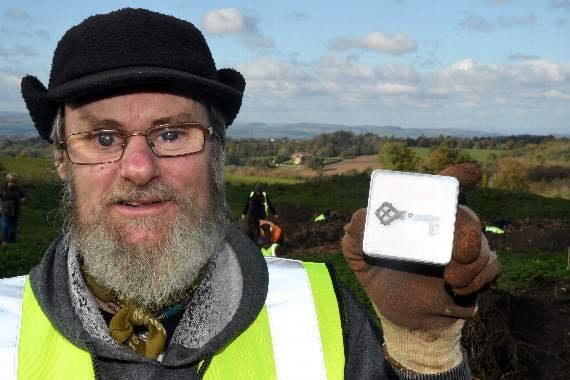
Among the finds have been medieval, glazed roof tiles – which indicate how luxurious a residence it was – and the key to a large chest, probably dating to the late 16th or early 17th century when it is thought it was abandoned.
Dozens of people turned up for tours of the site and to learn more from dig leader Robin Jackson.
He said: “It is, or it was, a castle but not much is known about it which is why we wanted to come here.
“It’s never been excavated as far as we know – there were some holes dug by treasure hunters in the 30s and some photos were taken of some of the little bits of standing castle that were left.
“We think the castle was built in the 11th century – that is pure supposition – and the reason we think that is that a lot of castles in this area were built around that time.
“Immediately after the Norman Conquest a string of castles were built all through the Marches – this is a great position to keep an eye on the Welsh.”
The transformation to a fortified manor house is indicated in written records with Alexander of Bicknor being given permission around 1310 by King Edward II to ‘crenellate’ Ruardean.
Crenellations are the iconic shape of castle battlements but the word can also be used loosely to mean ‘fortified’.
Mr Jackson said: “The Bicknors, who were the local family were granted licences to crenellate in the 13th and 14th centuries.
“They were given permission to fortify their place and we think that by that time there was a fortified manor here rather than one of the earlier castles.
“This is a splendid location to have your manor house fortified, both from the point of view of being imposing and of being a defendable position.
“It’s a high status dwelling – you are right by the church, you have beautiful views across what are presumably your lands.”
The archaeologor has
revealed the layout of this imposing medieval manor with a gatehouse, tower and and the living area inside a large defensive square.
Mr Jackson said: “The layout is starting to emerge, we have a gatehouse and behind it this enormous square walled strucure which probably has the fortified manor inside it and maybe buildings up against the outside.”
The tower also reveals the luxury that the Bicknors enjoyed, with a round, oriel
window overlooking the countryside – although even here there is a mystery.
Mr Jackson explained: “We came down onto the floor – we thought it was a step down but it kept on going down and down and we’re not sure what that is about.
“We thought that with a door and a fancy window it would be a chamber, so why earth is it plummeting away?
Could it have been a tight spiral staircase coming up the tower from an entrance below? It’s a bit of a mystery at the moment.”
Photographs from the 1930s also show what looks like a door arch and the archaeologists are keen to hear from any local people who have family photographs showing any aspects of the castle.
The interior walls were constructed with a row of good stone on the face and a core of rubble behind.
There is rubble left across the site but much of the good stone was probably taken by villagers to use in their homes, said Mr Jackson.
“All the good stone apart from the very base courses would have been taken away after the building had been abandoned and is in the farmhouses and older houses in the village.”
The splendour of the manor is also indicated by the discovery of glazed roof tiles – a “classic” find in high-status houses – and by the use of four different types
of stone.
Although much of the stone is local, there is also decorative Cotswold limestone.
“It could be that they were picking out details in different coloured stone to emphasise their wealth.”
The first trench to be opened revealed a lot of iron slag which is thought to have been a path to the castle or manor.
Mr Jackson said: “It looked like mud but it was actually compacted iron slag – it’s very common around here and its durable.”
Mr Jackson said that on one dig he had to use a jackhammer to get through a similar layer because it was too tough to work by hand.
Among the finds was a key to a chest, thought to have come from the end of the castle’s life in the early 17th century.
A map of Ruardean dated 1608 shows houses – but not the castle – in
three dimensions.
“We think that suggests the castle had been abandoned by then.”
The last job was to put down a breathable membrane to indicate to any future archaeologists where this group had worked.
Mr Jackson said: “We would like the chance to come back but whether or not we will I don’t know.
“As always happens with archaeological excavations, we started off with lots of questions and we answered some of them.
“We are showing structures in the gatehouse, we’ve shown the curtain wall, we’re getting dating evidence but what will undoutbtedly happen is that we will leave here with a raft of new questions that have emerged as a result of what we are doing – but that is the story of archaeology.”
The dig at Ruardean is the second of four community archaeological digs – the first was at Soudley Camp last year – that will carried out over the five years of the project.
Comments
This article has no comments yet. Be the first to leave a comment.