
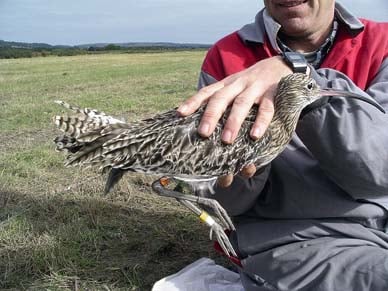
If they'd been close to Wibdon Warth, an area of low-lying marshland, they would have seen hundreds of yards of netting arcing into the sky and, seconds later, nearly 70 curlews flapping on the ground, trapped as it fell.
The team of British Trust for Ornithology experts in charge of the operation pounced and ringed 67 curlews at Wibdon.
The birds came from about 300 resting on a high tide roost. Another larger roost of 500 birds nearby remained entirely undisturbed.


The drive, led by netting and explosives expert Steve Dodd was carried out on the Severn Estuary with the permission of the landowner, and with authorisation from Natural England.
The purpose was partly to provide additional data for assessing the effect of possible tidal barrages on the Severn, and partly to contribute to a larger Trust project of monitoring turnover of waders at sites they regularly use.
"Curlew occur in Gloucestershire both as a breeding species and a wintering species," said Mike Smart, a trustee of Gloucestershire Wildlife Trust and international wetland expert.
"Most of the birds had almost regrown their feathers from moulting after the breeding season, showing Wibdon Warth is home to the birds for this important function," he said, adding that most of the birds came from northern Europe all the way up to the Arctic Circle.
"The marking with individual colour rings will enable them to be followed for years to come, to discover how important the River Severn is for them, where they go and what routes they take," said Mike, who counted the exercise a great success.
"Sometimes you can wait for ages and miss the birds," he said. "For this exercise we were worried first of all
because there were
two ravens on the roost and the curlews were frightened of them and wouldn't land," he said.
"Then fortunately a sailing boat went past and the ravens took off, allowing the curlews to move in."
Comments
This article has no comments yet. Be the first to leave a comment.