

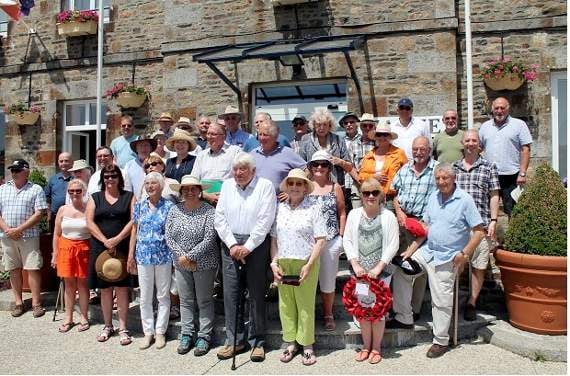
FORMER members of the British Army’s oldest reserve regiment travelled to Normandy to pay their respects to six young soldiers who lost their lives nearly 75 years ago.
The Monmouth-based Royal Monmouthshire Royal Engineers have only recently discovered the location of the August 12, 1944 tragedy, when a German shell hit their truck in the village of Vaudry, near Vire.
And it was to honour the memory of these fallen soldiers that a coach party of former RMRE members and their families and guests travelled to Normandy.
RMRE Dining Club secretary John Carter, who lives in Bream, said: “Their remains are buried in six beautifully kept graves in the nearby Saint Charles de Percy War Cemetery.

-ambulance.jpeg?width=209&height=140&crop=209:145,smart&quality=75)
“They were in a truck having a break from their engineering duties clearing mines and improving the roads when they were hit by a German shell. The truck was loaded with explosives and the explosion left little evidence of these six young men.”
The party travelled on Sunday, June 30 to meet the Mayor of Vaudry with her officials and a group of local veterans.
One of the party, 95- year-old Major Ken Grant, a Normandy veteran who landed on Gold Beach as a sapper in June 1944, was greeted with great respect, enthusiasm and gratitude by the French delegation at the Town Hall.
In a brief, emotionally charged speech, Mayor Annie Bihel warmly thanked the former soldiers for coming and reminded everyone that freedom is a precious asset that is sadly acquired at the cost of human life.
“She expressed the gratitude of the inhabitants of Vaudry and of France for the sacrifice of these young soldiers who gave their lives so that we could find hope,” said John.
“A message from the Commanding Officer of RMRE in Monmouth, Lieutenant Colonel Joe Gossage, was also read in which he thanked the people of Vaudry for caring for the last resting place of the regiment’s fallen for the last 75 years.”
Colonel Tony George, a former commanding officer and regimental honorary colonel, then presented the mayor with an RMRE plaque, after which Major Jen Pride, a former regimental officer, gave a description of what the unit had been doing from landing on the beaches up to the date of the explosion.
Major Pride then laid a poppy wreath in the Town Hall in memory of the six who lost their lives.
“The mayor said the RMRE plaque and poppy wreath would remain on permanent display in her office in the Town Hall,” said John.
The six young soldiers who died were William Anderson, 21, from Lanarkshire; Frederick Barr, 28 and married, from Nottinghamshire; Joseph Booker, 21, from Staffordshire; Robert Currie, 24 and married, from Dunbartonshire; James Fitzgerald, 23 and married, from Warwickshire and Leonard Lang, 29 and married, from Cardiff.
There may be surviving or next generation family members of these casualties who may not be aware that the location of their relative’s death has recently been discovered.
The trip organiser, who also lead the research, is anxious to contact them and he may be contacted through the Regimental Museum at Monmouth on 01600 772175 or email: [email protected]
Comments
This article has no comments yet. Be the first to leave a comment.